Origin and Taxonomy
One question that always made
me wonder was how anacondas had become anacondas. Their ancesetors
was something not that different of your average boa
constrictor or a rainbow boa, as it turns out, and somehow
they became the massive snakes they are today. That made me wonder not on so much about anacondas
ecology that I had been studying for a few years but about their past. When did
they become anacondas? Where? Why? How?
 Because the llanos, where I have been studying them
for decades is only 10K years old, it was not possible that they evolved in the
llanos. That on
itself made me wonder more about the question.
What was the environment in which they really evolved? This lead me through a fascinating rabbit
hole of discovery of questions that I would have never thought of, otherwise. I started studying Paleo-history of South
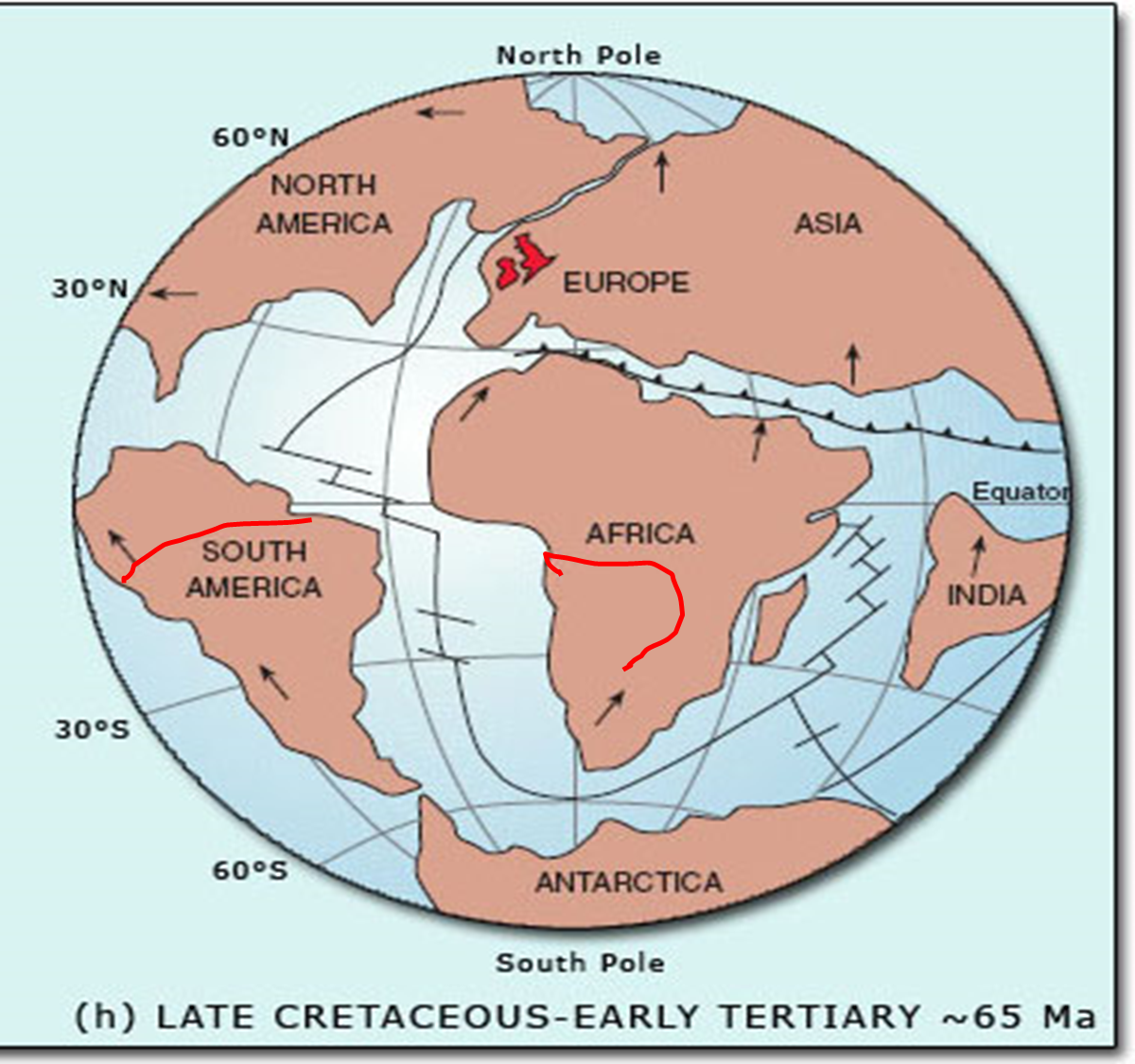
America. It turns out that when South
America separated from Africa, it was drained by a mayor river, the
Proto-Amazons, that ran west. Clearly
all continents drain to the outside and Gondwana was no exception. The western part of Gondwana, that became
South America, drained to the west. This
separation of the big river left the Congo river in Africa and the Proto Amazon
in South America. At this time it was likely a very similar river than
it is now draining similar watershed by running west (as shown in the figure on
the left in red). As the continent drifted
to the west, it collided with the Nazca Plate, in the Pacific Ocean. This collision resulted in Nazca subsiding
under South America with the consequent raise of the Andes.
What would happen if you build a dam 7000 kilometers
long to the largest river in the world?
Because the llanos, where I have been studying them
for decades is only 10K years old, it was not possible that they evolved in the
llanos. That on
itself made me wonder more about the question.
What was the environment in which they really evolved? This lead me through a fascinating rabbit
hole of discovery of questions that I would have never thought of, otherwise. I started studying Paleo-history of South
America. It turns out that when South
America separated from Africa, it was drained by a mayor river, the
Proto-Amazons, that ran west. Clearly
all continents drain to the outside and Gondwana was no exception. The western part of Gondwana, that became
South America, drained to the west. This
separation of the big river left the Congo river in Africa and the Proto Amazon
in South America. At this time it was likely a very similar river than
it is now draining similar watershed by running west (as shown in the figure on
the left in red). As the continent drifted
to the west, it collided with the Nazca Plate, in the Pacific Ocean. This collision resulted in Nazca subsiding
under South America with the consequent raise of the Andes.
What would happen if you build a dam 7000 kilometers
long to the largest river in the world?
As
the Nazca plate started subsiding under South America (some 90 mya) it would
have started to make the mouth of the big river 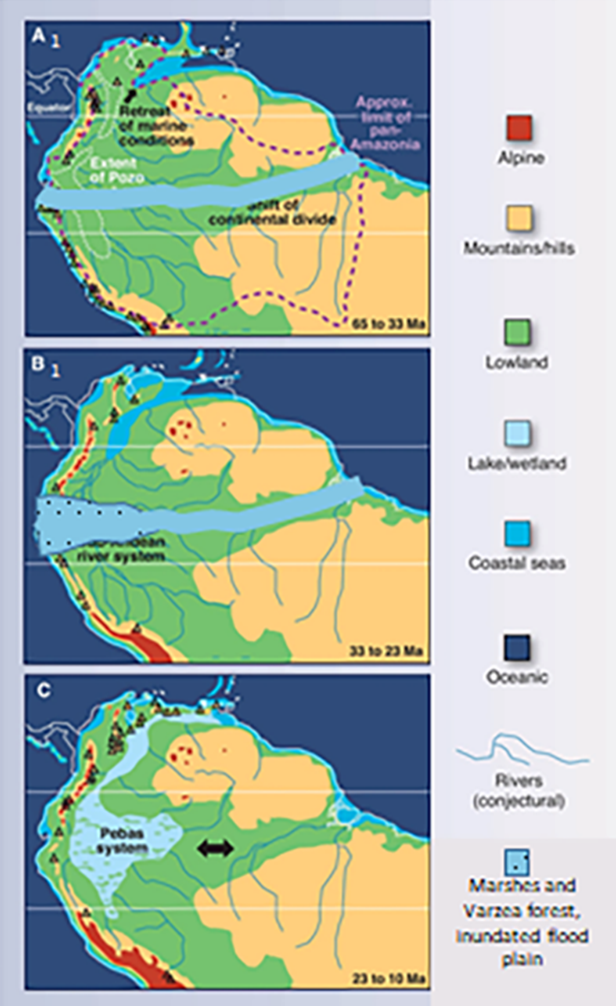 swallower. Over time it would have lead
it to overflow it seasonal floodplains permanently. As the river became shallower it would have
resulted in the progressive and quasistatic flooding of all the western part of
the continent as shown in the figure of the left. The slow flooding of the continent lead to
the evolution of various aquatic lineages from terrestrial ones. This lead to the appearance
of Chelus, (matamata turtle) an aquatic turtle
specializing in small forest creeks around 70 mya. Also
around 60 mya South American side-necked turtles (Podocnemidoidae)
diversified into new lineages. At this time too, 60 mya, Alligatorids
split into two lineages, a larger one, Caiman that prefers rivers and lagoons,
and Paleosuchus spp
that is a smaller forest specialist living in small creeks inside the forest.
Approximately 58 mya Titanoboa an aquatic lineages of
snakes, split from terrestrial lineages and between 50–40 mya Eunectes
diversifies from its terrestrial ancestors. Also 40–35 mya Teidae a group of terrestrial lizards, diversifies
producing two aquatic linages, Crocodilurus
and Dracaena. Approximately, 40 mya, the caiman lineage had another
split giving raise to the larger genus, Melanosuchus,
which occupies large water bodies. Last, approximately 49 mya we see the
appearance of a strictly arboreal lineage of boids, Corallus. Specialization to living on the trees
could be an evolutionary response of a flooded
understory that was unavailable. Taken together, this scenario speaks of a
generalized increase of habitat for aquatic lineages throughout the continent
and supports the notion that the continent was flooding very slowly, consistent
with the geological
damming of a big river. It produced
a long lasting flooded that produced their imprint on
the diversity of all species of South America. Eventually the big Swamp filled up with sediments
and tectonic pressure lead the river to drain East as it does now.
swallower. Over time it would have lead
it to overflow it seasonal floodplains permanently. As the river became shallower it would have
resulted in the progressive and quasistatic flooding of all the western part of
the continent as shown in the figure of the left. The slow flooding of the continent lead to
the evolution of various aquatic lineages from terrestrial ones. This lead to the appearance
of Chelus, (matamata turtle) an aquatic turtle
specializing in small forest creeks around 70 mya. Also
around 60 mya South American side-necked turtles (Podocnemidoidae)
diversified into new lineages. At this time too, 60 mya, Alligatorids
split into two lineages, a larger one, Caiman that prefers rivers and lagoons,
and Paleosuchus spp
that is a smaller forest specialist living in small creeks inside the forest.
Approximately 58 mya Titanoboa an aquatic lineages of
snakes, split from terrestrial lineages and between 50–40 mya Eunectes
diversifies from its terrestrial ancestors. Also 40–35 mya Teidae a group of terrestrial lizards, diversifies
producing two aquatic linages, Crocodilurus
and Dracaena. Approximately, 40 mya, the caiman lineage had another
split giving raise to the larger genus, Melanosuchus,
which occupies large water bodies. Last, approximately 49 mya we see the
appearance of a strictly arboreal lineage of boids, Corallus. Specialization to living on the trees
could be an evolutionary response of a flooded
understory that was unavailable. Taken together, this scenario speaks of a
generalized increase of habitat for aquatic lineages throughout the continent
and supports the notion that the continent was flooding very slowly, consistent
with the geological
damming of a big river. It produced
a long lasting flooded that produced their imprint on
the diversity of all species of South America. Eventually the big Swamp filled up with sediments
and tectonic pressure lead the river to drain East as it does now.
This is the likely scenario where anacondas
evolved. A progressively flooded forest
that lead the terrestrial species to adapt to aquatic
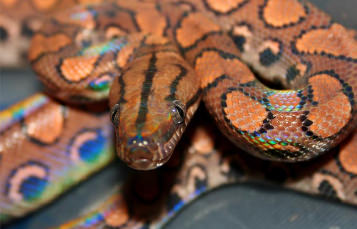
life. The closest relative of Eunectes
are Epicrates, rainbow boas
which are generalist snakes living in the ground, up in the canopy and can easily
go in the water when needed. As the forest
floor flooded hiding under water to ambush prey would have been beneficial. As time passed natural selection would have
favor coloration that blends in with aquatic vegetation to better hide. Because the water relieve
them from the constraints of gravity, they were able to grow to larger sizes. Also, water allowed them to hide their large body which allowed them to stalk prey
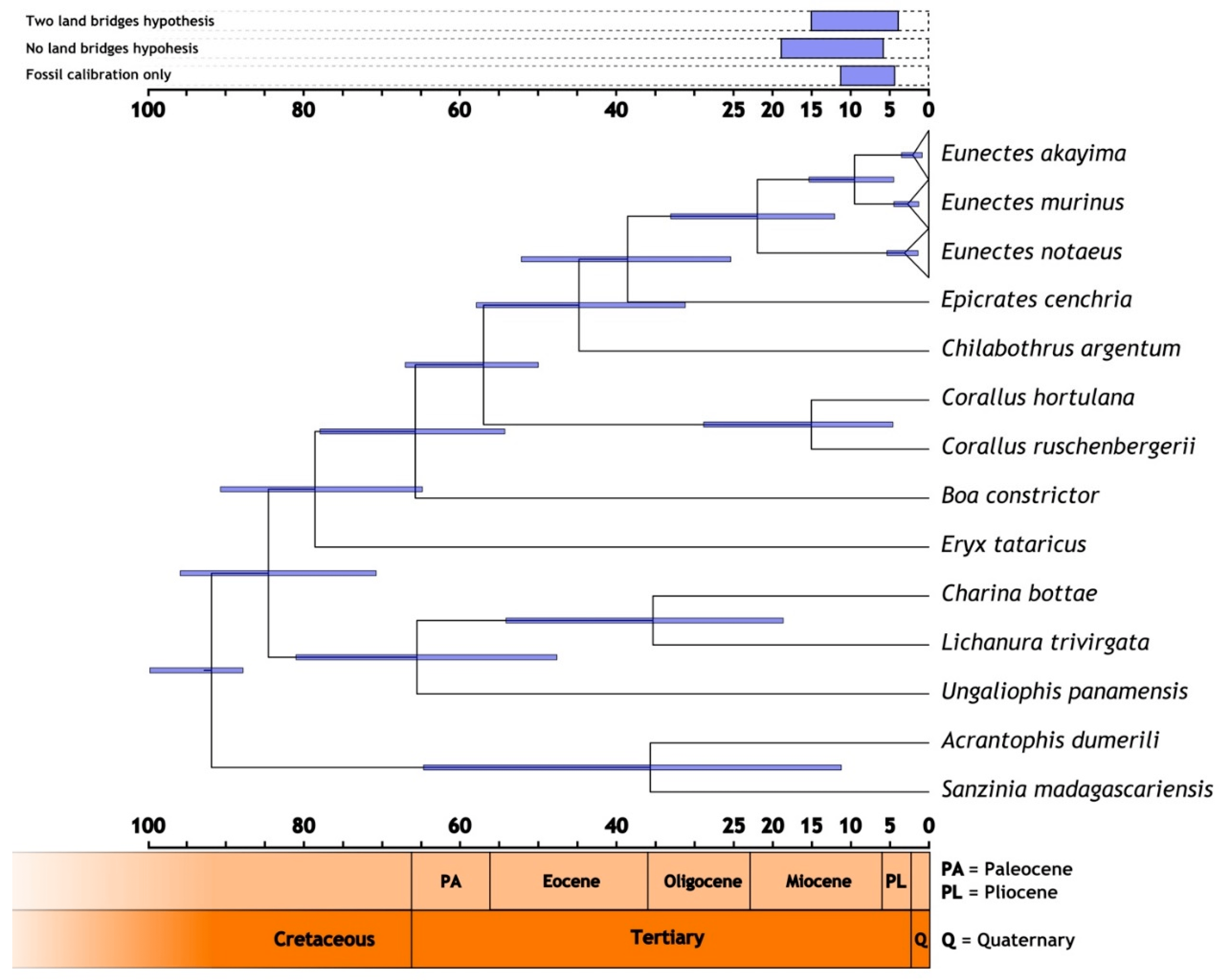
despite of their large size. Data shows that this transformation occurred some
37 mya (as shown in the figure on the left).
While
the permanent waters of the Pebas system that formed about 24 mya when the river
was fully blocked may have allowed the evolution of large-bodied aquatic
specialists, the specific topology of the adjacent area might be the reason for
the evolutionary preservation of smaller-bodied relatives. Due to the extremely
flat relief of the area (1.5 cm/km;), a small change in the water level would
have resulted in a substantial displacement of the water edge. The Eunectes
populations living at the edges of the hyper-seasonal Pebas system would,
therefore, need to travel long distances on dry land to track the receding
waters in every dry season. The need to move across dry land might have
constrained their growth, thus maintaining a lineage of small-bodied anacondas
(E. notaeus sensu lato including Yellow
anacondas, Beni anacondas and Dark spotted anaconda). Since Pebas drained
toward the north, there would have been a constant volume of water in this
direction, causing only large-bodied anacondas (E. akayima) to be found
toward the north of the Pebas system. This would explain today’s lack of
small-bodied Eunectes to the north of Pebas, even today with part of the
area possessing developed hyper-seasonal Savannahs because these are new
ecosystems.
This
scenario allows to explain that surprising lack of
fish on anaconda diet. Despite the fact that fish are a very
good nutrition and are very abundant, anacondas do not use them regularly (or
at all) in their diet. Our data shows that they do not relay
on fish for their diet. Because there
were large extensions of forest with only a shallow layer
of water, large fish could not come into the forest. The warm water under the shade of the forest
would have ben anoxic, or at
least dysoxic, and would have been unable to support much fishes. Thus anacondas became anacondas ambushing terrestrial prey that
wandered in the forest or that came close to the river channels where it
lived. Having an ample supply of
terrestrial prey, it never evolved the capacity to hunt under water that has
substantial hydrodynamic challenges for the regular strike pattern that most
snakes use.
 Our
molecular clock analyses indicate the smaller anacondas (E. notaeus
complex) separated into three different groups relatively recently, some 2.5
mya. Which has not seem
enough time for their lineages to really diverge. In a recent study we found not only that
their genetic distance is very close to one another but also that their
distribution largely overlap throughout South America so
there is no legitimate reason to consider them different species.
Our
molecular clock analyses indicate the smaller anacondas (E. notaeus
complex) separated into three different groups relatively recently, some 2.5
mya. Which has not seem
enough time for their lineages to really diverge. In a recent study we found not only that
their genetic distance is very close to one another but also that their
distribution largely overlap throughout South America so
there is no legitimate reason to consider them different species.
IN addition,
our analyses indicate that E. akayima and E. murinus diverged in
the Miocene at the same time that other South American
taxa were undergoing similar-aged north–south divergences. The vicariant event
splitting these lineages might have been associated with the uplift of the
Vaupés arch, an elevation that connected the Andes with the Guyana shield on
the southern end. The rise of this arch separated the north from the south, in
what is now the Venezuelan and Colombian Llanos. This was the result of the
continent-wide readjustment of the landscape that resulted in tilting the
continent to the east and the separation of the Proto-Orinoco and Proto-Amazon
River into their current descendants. The rise of this arch occurred almost
synchronously to the split of these clades. So, this was likely the vicariant
event that separated these two species. Looking at the big picture,
combined, the presence of the Pebas system as a barrier for dispersal of
shallow water organisms as well as the
Vaupés arch splitting the watersheds likely explain the separation between the
north and south of much of the aquatic fauna in South America including not
only anacondas but also caimans, matamata turtles, stingrays, Prochilodontidae fishes (Characiforme),
Cyprinodontoidei fishes (Cyprindodontiforme),
catfishes [43], Serrasalmidae fishes (Characiforme), gecko lizards [46], and Anole lizards [47],
as well as arboreal snakes
Placing and indigenous name at par with names given by western scientist was unconventional and angered many of the well established taxonomists who had their implicit biases take the better of them. However, we felt that the name given by a person who never saw the snake alive and only knew it from a jar shoul not tkae precedence over the name given by the people who live with the snake and shared their lives and territorie with it. Some, mostly, European scientist responded with anger arguing even
Some of the articles supporting this page are below
Rivas, J.A.; Terra,
J.S.; Roosen, M.; Champagne, P.S.; Leite-Pitman, R.; De La Quintana, P.;
Mancuso, M.; Pacheco, L.F.; Burghardt, G.M.; Vonk, F.J.; Garcia-Pérez, J.E.,
Fry, B.G., Corey-Rivas, S.. 2024. Description of the
Northern Green Anaconda (Eunectes akayima sp. nov.
Serpentes; Boidae): What Is in a Name? Diversity 2024,
16, 418. https://doi.org/10.3390/d16070418.
Rivas,
J. A., de La Quintana, P., Mancuso, M., Pacheco, L. F., Rivas, G. A., Mariotto,
S., Salazar-Valenzuela, D., Baihua, M. T., Baihua, P., Burghardt, G. M., Vonk, F. J., Hernandez, E.,
García-Pérez, J. E., Fry, B. G., & Corey-Rivas, S. 2024. Disentangling
the Anacondas: Revealing a New Green Species and Rethinking Yellows. Diversity,
16(2), 127. https://doi.org/10.3390/d16020127
Rivas J.A. 2023. The Missing River. Frontiers in
Earth Science 11:1203667: 1–4. https://doi.org/10.3389/feart.2023.1203667
.
Rivas, J. A.
2020. Climate changes and speciation
pulses in a nearly flooded continent: tackling the riddle of South America’s
high diversity. Ecotropicos. 32:e0014. https://doi.org/10.53157/ecotropicos.32e0014